Medical direction: Dr. Mouza Al Suwaidi, Canadian Board-Certified Consultant Dermatologist, EDCC Abu Dhabi | Last updated: November 2026
If your face stings, itches or breaks out in a rash after using a cream, cleanser, sunscreen, perfume or hair dye, the cause may be irritation or a true allergy called allergic contact dermatitis. The two look alike but need different management. Patch testing is the standard test dermatologists use to find the allergen behind a delayed skin allergy. If you live in the UAE and keep reacting to skincare products, patch testing in Abu Dhabi at a dermatology clinic can help you find the trigger instead of guessing.
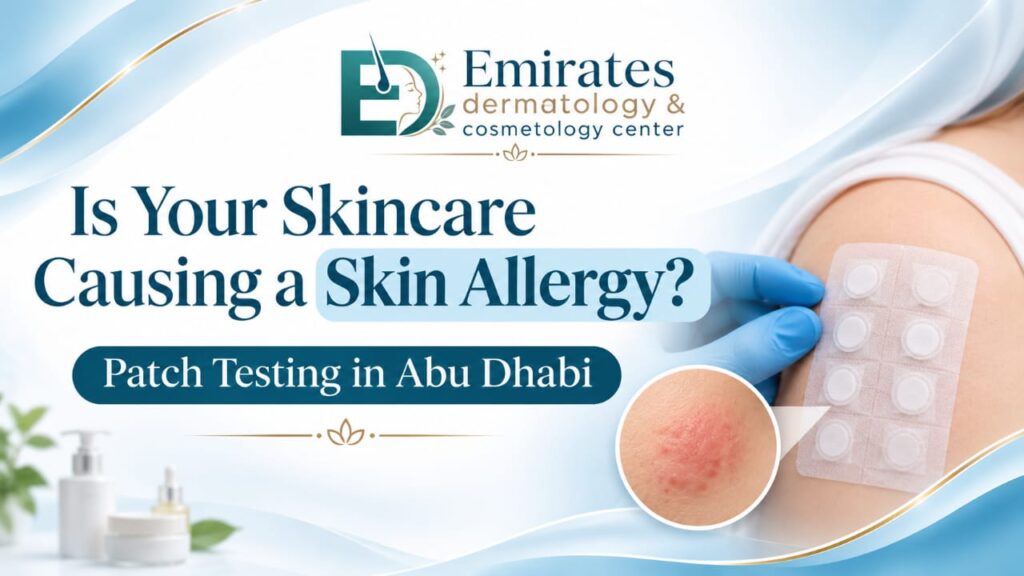
Is Your Skincare Causing a Skin Allergy?
Skincare products are made to protect and improve the skin. But some ingredients can irritate the skin or trigger an allergic reaction in certain people. Redness, itching, dryness, burning and a rash that keeps coming back can all be signs that your skin is reacting to something in a cosmetic or personal care product. A reaction does not always show up straight away. Some people develop symptoms after weeks or months of using a product that was fine before. This happens because allergic contact dermatitis builds up over time: the immune system becomes sensitised to a substance and then reacts when it meets it again. Finding the real trigger matters. Switching products again and again without knowing the cause often keeps the problem going. In suitable cases, a dermatologist may recommend patch testing to investigate a suspected allergy.
Why Can Skincare Products Cause Skin Allergies?
Skincare and cosmetic products contain many ingredients: fragrances, preservatives, plant extracts, dyes and active ingredients. Most are safe for most people, but a few can trigger allergy in susceptible users.
1. Fragrances
Fragrance ingredients are found in moisturisers, cleansers, sunscreens, perfumes and many other products. Some can cause allergic contact dermatitis. Even products labelled “for sensitive skin” can contain fragrance-related ingredients, so always check the full ingredient list.
2. Preservatives
Preservatives keep products safe from bacteria and mould. A few of them can cause allergic reactions in some people.
3. Botanical and plant extracts
“Natural” does not mean allergy-free. Essential oils, plant extracts and other botanical ingredients can trigger contact allergies.
4. Hair dye ingredients
Certain hair dye chemicals can cause allergic contact dermatitis. Reactions can affect the scalp, hairline, ears, face and neck.
5. Active skincare ingredients
Exfoliating acids and retinoids often cause irritation, especially when used too often or at too high a strength. Irritation is not the same as an allergy, and telling them apart is an important step.
Symptoms of a Skincare Allergy
A reaction to a skincare or cosmetic product can cause:
- Redness or inflammation
- Persistent itching
- Dry, flaky or scaly skin
- Burning or stinging
- Small bumps or blisters
- Swelling around the area
- A rash that returns after using a certain product
Symptoms can appear on the face, eyelids, lips, neck, hands or any area that touches the trigger. In allergic contact dermatitis, the rash often appears hours or days after exposure, which is why the culprit product is hard to spot without proper assessment.
Facial rashes and eyelid irritation deserve extra attention, because several different skin conditions can look the same.
Skin Irritation vs Allergic Contact Dermatitis
Not every reaction to skincare is an allergy. Two common causes are irritant contact dermatitis and allergic contact dermatitis.
Feature | Irritant contact dermatitis | Allergic contact dermatitis |
|---|---|---|
Main cause | Direct damage to the skin barrier | Immune reaction to a specific allergen |
Common symptoms | Burning, dryness, stinging, redness | Itching, redness, swelling, sometimes blisters |
Timing | Soon after exposure or after repeated use | Often delayed, hours to days after exposure |
Who gets it | Anyone can develop irritation | People who have become sensitised to the allergen |
Patch testing | Does not diagnose ordinary irritation | Can help identify the responsible allergen |
The two can look similar and can even happen together. A dermatologist looks at your symptoms, the areas affected and your product history to work out the likely cause.
What Is Patch Testing?
Patch testing is a diagnostic test used to find substances that cause allergic contact dermatitis, a delayed allergic reaction of the skin. Small amounts of selected test substances are placed in small chambers on patches, which are taped to the skin, usually on the upper back. The skin is not broken, and no needles are used.
The patches stay on for a set time, and the dermatologist then checks the skin for reactions. A positive reaction suggests you are sensitised to that substance. Your dermatologist then judges whether it explains your symptoms, based on your history and the products you use.
This is different from a skin prick test, which checks for immediate allergies such as hay fever or food allergy and gives a result within minutes. Patch testing looks for delayed reactions that take days to appear.
Patch testing can investigate suspected allergy to:
- Fragrance ingredients
- Preservatives
- Other cosmetic ingredients
- Hair dye chemicals
- Metals
- Some topical medicines
- Other substances that touch the skin
The substances tested depend on your history and your dermatologist’s assessment.
How Does Patch Testing Work? Step by Step
Step 1: Consultation
The dermatologist reviews your symptoms, medical history and the products that may be involved. Bring your skincare, makeup, hair dye and perfume, or photos of the ingredient lists. This helps decide which allergens to test.
Step 2: Applying the patches
Selected substances are applied to patches and taped to your upper back. They need to stay in place and stay dry for the full testing period.
Step 3: First reading (around 48 hours)
The patches are removed after about 48 hours, and the dermatologist checks the skin for reactions. The test sites are usually marked so they can be found again.
Step 4: Delayed reading (around day 4 or 5)
Some allergic reactions appear later, so a second reading is needed, commonly 72 to 144 hours after the patches were applied. This step matters: in a large study of nearly 10,000 patients, a single reading at 48 hours missed about one-third of positive reactions.
Step 5: Results and avoidance advice
The dermatologist explains which substances you reacted to, whether they are relevant to your rash, where they may be hidden (in cosmetics, hair dye, perfumes or other products) and how to avoid them.
The exact schedule and the substances tested can vary between clinics and patients, and your dermatologist will confirm yours.
How to Prepare for Patch Testing
General preparation advice from patch testing clinics includes the points below. Always follow your own dermatologist’s instructions, and do not stop prescribed medicines on your own.
- Avoid sun and tanning on your back for a few weeks before the test, as advised by your clinic.
- Skin on your back should be free of rash on the day the patches are applied.
- Tell your doctor about all medicines. Some steroid creams on the test area, oral steroids, immunosuppressants and phototherapy can affect results. Antihistamines generally do not interfere, but confirm this with your clinic.
- Keep the patches dry. No swimming, soaking or heavy sweating while they are on. Plan the test for a time when you can avoid intense exercise.
- Wear loose clothing that will not rub the patches loose.
- Do not remove the patches yourself unless your doctor tells you to. If a patch comes off or you have severe itching or pain, contact the clinic.
Who Should Consider Patch Testing?
A dermatologist may suggest patch testing if you have:
- Repeated facial rashes after using skincare or makeup
- Long-lasting eyelid redness, swelling or itching
- Recurring hand eczema
- Reactions to perfumes or hair dyes
- Dermatitis that does not improve with routine treatment
- Suspected reactions to products at work or at home
Patch testing is not needed for everyone with dry or sensitive skin. Your symptoms, history and suspected cause guide the decision.
What Patch Testing Cannot Do
Patch testing is designed for delayed allergic contact dermatitis. It has limits:
- It does not diagnose ordinary irritant contact dermatitis.
- It is not the standard test for immediate food or environmental allergies.
- It cannot test every possible ingredient in every product.
- A positive result does not automatically mean that substance is causing your current rash.
Depending on your symptoms, other tests or treatment may be needed.
Is Patch Testing Safe? Possible Side Effects
Patch testing is widely used and generally well tolerated, but it can cause effects:
- Itching or discomfort under the patches
- Redness or irritation from the tape
- A strong reaction at a test site, which may blister
- A flare of your existing dermatitis
- A temporary mark on the skin at a positive test site, and rarely a longer-lasting one
Tell your dermatologist if you have severe itching, pain or blistering. Tests must be done and read by a trained professional.
What to Do If a Skincare Product Causes a Reaction
- Stop the suspected product until you get advice.
- Do not add several new products while your skin is irritated.
- Keep the packaging and ingredient list.
- Note when symptoms began and how often you used the product.
- See a dermatologist if the reaction persists, comes back or gets worse.
Avoid repeatedly testing suspected products on inflamed skin. Do not assume a product is safe because it says natural, hypoallergenic or suitable for sensitive skin.
Get urgent medical care if you have difficulty breathing, throat swelling or other signs of a severe immediate allergic reaction.
Patch Testing in Abu Dhabi at EDCC
Recurring skin reactions are frustrating, especially when you cannot tell which product is responsible. At EDCC, your visit starts with a proper assessment under the direction of Dr. Mouza Al Suwaidi, a Canadian Board-Certified Consultant Dermatologist.
What you can expect:
- A detailed review of your symptoms, history and the products you use
- A clear explanation of whether patch testing is right for you, or whether another approach would help more
- The testing schedule, preparation and aftercare explained before you begin
- Results explained in plain language, with advice on avoiding your triggers
EDCC, Abu Dhabi 101/102, First Floor, Building 3, Al Khazzaf Street, Al Nahyan Camp, Next to Al Mamoura, Abu Dhabi Phone: +971 2 5555 255
Frequently Asked questions
FAQ
Patch testing is a test that places small amounts of possible allergens on your skin under patches, usually on the back, to find the cause of allergic contact dermatitis. The patches stay on for about 48 hours, and the skin is checked for reactions afterwards.
The patches are usually worn for about 48 hours, with a first reading when they are removed and a delayed reading a few days later, commonly around day 4 or 5. Your clinic will give you the exact schedule.
No needles are used and the skin is not broken. Some people feel itching or mild discomfort under the patches. Tell your clinic if the itching or pain becomes severe.
Usually not. The patches must stay dry and in place, so showering, swimming and heavy sweating are avoided. Sponge washing of other areas is generally fine. Follow your clinic’s instructions.
A skin prick test checks for immediate allergies, such as hay fever or food allergy, and gives results in minutes. A patch test checks for delayed skin allergy (allergic contact dermatitis), and results take days.
It can help identify the ingredients you are sensitised to, such as fragrances or preservatives. Your dermatologist then matches these with the ingredient lists of your products. It cannot test every ingredient, so results are interpreted together with your history.
Your dermatologist will explain whether the allergen is relevant to your rash, where it can be found, and how to avoid it. You will also get advice on suitable skincare and treatment for your skin.
Yes. These labels are not a guarantee. Fragrance, preservatives and plant extracts can still be present, so check the full ingredient list.
The cost depends on your assessment and the number of substances tested. Contact EDCC for a personalised quotation after your consultation.