
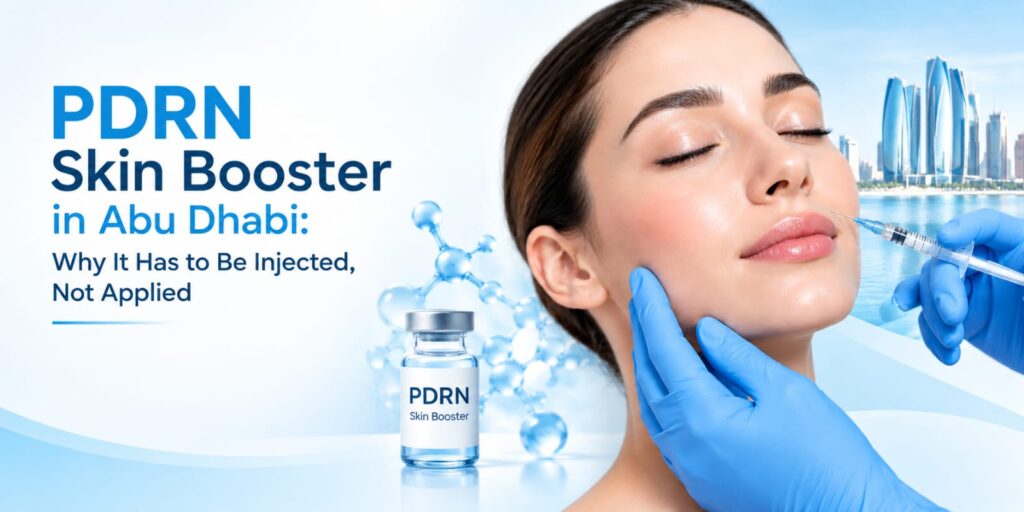
If you’ve searched “PDRN” recently, you’ve probably come across two very different things being sold under the same name: injectable treatments at clinics, and “PDRN creams” sold as skincare products. They are not equally effective, and understanding why matters before you spend money on either.
PDRN — polydeoxyribonucleotide — is a regenerative ingredient derived from purified DNA fragments (commonly from salmon), used in skin treatments for its ability to support tissue repair, stimulate collagen production, and improve overall skin quality. It’s genuinely different from a standard hyaluronic acid skin booster: where HA primarily hydrates by attracting and holding water in the skin, PDRN works by signaling the skin’s own repair processes — closer to a “skin healer” than a pure hydrator.
Here’s the honest, often-skipped detail: PDRN only works meaningfully when it reaches the deeper layers of skin where it can interact with cells — and topical creams generally can’t achieve this. PDRN is a relatively large molecule, and the skin’s outer barrier is specifically built to keep larger molecules out. This is why clinically meaningful PDRN treatment is delivered by injection, directly into the skin’s mid-layers, not applied as a surface cream. If you’ve seen “PDRN cream” or “PDRN serum” marketed for daily use, it’s worth understanding that the scientific evidence for topical PDRN penetrating skin effectively is considerably weaker than for the injectable form.
At EDCC, PDRN skin booster treatment is performed under the direction of Dr. Mouza Al Suwaidi, a Canadian Board-Certified Consultant Dermatologist, using a professional injectable protocol combined with hyaluronic acid and niacinamide.
A Note on Brand Names
You may see PDRN treatments marketed under specific brand names like “Rejuran.” Here’s a useful distinction: Rejuran is a specific branded PDRN product — every Rejuran treatment is a PDRN treatment, but not every PDRN treatment is Rejuran. Clinics may use different PDRN formulations, and it’s reasonable to ask which specific product is being used during your consultation.
How It’s Different From Standard Hyaluronic Acid Skin Boosters
| PDRN Skin Booster | Standard HA Skin Booster | |
|---|---|---|
| Primary mechanism | Stimulates tissue repair and collagen production | Attracts and holds water for hydration |
| Best suited for | Skin repair, scarring, overall skin quality | Hydration, mild fine lines, skin glow |
| Texture improvement | Often more pronounced over time, as repair mechanisms activate | Primarily hydration-driven improvement |
| Typical course | Often 3 sessions, spaced weeks apart | Varies, commonly 1-3 sessions |
PDRN and HA aren’t competing options — many patients benefit from a combined approach, which is part of why EDCC’s protocol includes hyaluronic acid and niacinamide alongside PDRN.
What to Expect: EDCC’s Three-Session Protocol
- Consultation & assessment — skin concerns, goals, and candidacy are assessed, including any contraindications.
- Preparation — the treatment area is cleansed; topical numbing may be used for comfort.
- Injection — PDRN combined with hyaluronic acid and niacinamide is delivered via microinjections across the treatment area.
- Course of sessions — EDCC’s protocol typically involves three sessions, spaced a few weeks apart, allowing the skin’s repair response to build progressively.
- Aftercare — minimal downtime; mild redness or small bumps at injection sites typically resolve within a day or two.
Expected Results Timeline
- After session 1: Subtle hydration and glow improvement begins
- Weeks 2-4: Texture and tone improvements become more noticeable as repair mechanisms activate
- After the full 3-session course: Cumulative improvement in skin texture, tone, and overall quality, with results that build progressively rather than appearing all at once
Areas Commonly Treated
PDRN skin booster isn’t limited to the face — common treatment areas include:
- Face — overall texture, tone, and skin quality
- Under-eyes — a frequently requested area, given PDRN’s tissue-repair properties
- Neck and décolletage — areas often neglected in skincare routines but equally prone to visible aging
- Scalp (as part of hair-focused protocols) — supporting scalp health alongside other treatments
Which areas suit your goals is assessed during consultation, not assumed from a generic package.
An Honest Look at Risks
PDRN skin booster is generally well-tolerated, but it’s still an injectable procedure and isn’t entirely risk-free. The most common temporary effects are mild redness, swelling, or small bumps at injection sites, usually resolving within a day or two. Bruising is possible, as with any injectable. Because PDRN is commonly derived from salmon DNA, a known fish allergy is a genuine contraindication worth disclosing clearly during consultation — this is exactly the kind of detail easy to overlook if a clinic doesn’t ask directly.
What to avoid alongside PDRN treatment: Avoid combining with other injectable or exfoliating treatments (like strong retinoids or chemical peels) in the same treatment window without your practitioner’s guidance, since this can increase irritation risk during the healing period. Blood-thinning medications or supplements may also increase bruising risk and are worth mentioning during consultation.
Who’s a Good Candidate?
Likely a good fit if you have:
- Dull, fatigued-looking skin not responding well to topical skincare alone
- Early textural concerns, mild scarring, or overall skin quality you’d like to improve
- Realistic expectations for gradual, cumulative improvement over a course of sessions
Best to postpone or avoid if you’re:
- Pregnant or breastfeeding
- Dealing with an active skin infection in the treatment area
- Living with a known fish allergy (see risks section below — a genuine contraindication given PDRN’s common salmon-derived origin)
Cost of PDRN Skin Booster in Abu Dhabi
The cost of treatment varies based on individual needs and the recommended treatment plan. Please contact EDCC to receive a personalised quotation after consultation.
Frequently Asked questions
FAQ
No. Medical camouflage conceals the visible color contrast of vitiligo patches — it does not treat the underlying condition or restore natural pigmentation biologically. It’s a cosmetic option that can be used alongside or independently of medical treatment for vitiligo.
It’s formulated to be water-resistant and long-wearing, generally lasting through a full day of normal activity, though this varies by activity level and the specific area treated. It typically needs reapplication after swimming or very heavy sweating.
Yes. It uses specially formulated, high-pigment, water-resistant (anhydrous) creams designed for durability and precise color matching, applied with a technique different from standard makeup application.
No — these are two different techniques. Medical camouflage (offered at EDCC) is topical and temporary, reapplied as needed. Micropigmentation is a separate, tattoo-based technique that implants pigment into the skin and lasts roughly 2-3 years. If you’ve heard “medical camouflage” used to describe a permanent or tattoo-based option, that’s referring to micropigmentation specifically.
Yes — this is exactly what medical camouflage is designed for. Standard makeup and concealer often don’t provide enough coverage or durability for vitiligo patches, which is why specially formulated, water-resistant camouflage creams are used instead, along with proper color-matching technique.
Yes. It’s commonly used for surgical scars, burn scars, stretch marks, and areas of uneven pigmentation, in addition to vitiligo.
The cost of treatment varies based on individual needs and the recommended treatment plan. Please contact EDCC to receive a personalised quotation after consultation.
Ready to talk it through? Book a consultation at EDCC — PDRN treatment protocols are medically directed by Dr. Mouza Al Suwaidi.