
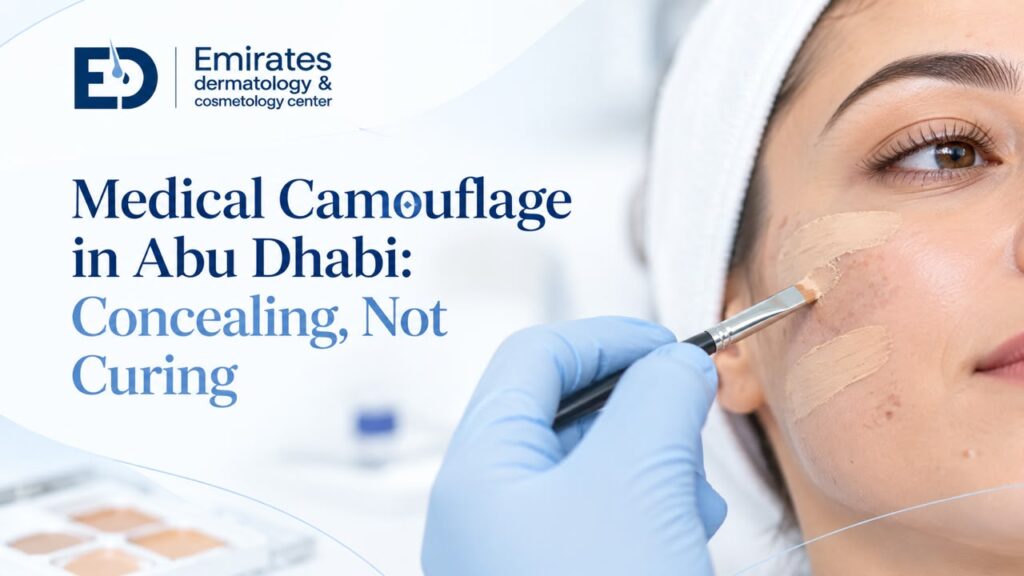
Medical camouflage is a specialized cosmetic technique that conceals visible skin differences — using high-coverage, water-resistant creams precisely color-matched to your natural skin tone. It’s worth being clear upfront about what this treatment is and isn’t: medical camouflage improves the visible appearance of a skin condition by concealing the color contrast — it does not treat or cure the underlying condition itself. For conditions like vitiligo, the goal is reducing how visible the patches are day-to-day, not repigmenting the skin biologically.
This distinction matters for realistic expectations. If you’re looking for a treatment that addresses the underlying cause of vitiligo, scarring, or pigment loss, that’s a separate conversation with your dermatologist — medical camouflage is a complementary, cosmetic option that can be used alongside or instead of medical treatment, depending on your goals.
At EDCC, medical camouflage is offered under the direction of Dr. Mouza Al Suwaidi, a Canadian Board-Certified Consultant Dermatologist.
A Technique With Real Clinical History
Medical camouflage isn’t a modern beauty trend — it has a genuine clinical history. The concept originated during the Second World War, when plastic surgeons working with the British Royal Air Force developed durable, skin-colored preparations to help conceal burn scars in injured pilots. The technique was later formalized by Joyce Allsworth, who founded the British Association of Skin Camouflage in 1985. Today, it’s a recognized supportive option in dermatology for a range of conditions where visible skin differences affect quality of life.
What Medical Camouflage Can Help With
- Vitiligo / areas of depigmentation
- Scars — including surgical, traumatic, and selected acne scars
- Burn scars
- Stretch marks (striae)
- Areas of uneven skin pigmentation or discoloration, where appropriate
- Post-surgical skin color differences, including selected scars after procedures
How It’s Different From Regular Makeup
Medical camouflage uses specially formulated, high-pigment, water-free (anhydrous) foundations — a different formulation from standard makeup, designed to stay put through sweat, water, and daily activity without transferring. Proper application technique is genuinely different from regular foundation application, which is why training and experience in the specific technique matters for a natural-looking result, not just access to the right product.
Topical Camouflage vs. Micropigmentation: Which Is Which?
“Medical camouflage” is sometimes used loosely to describe two genuinely different approaches, and it’s worth being clear about which is which before you book:
- Topical camouflage (what’s covered on this page) — high-coverage, water-resistant creams applied to the skin’s surface. Temporary, reapplied as needed, and fully reversible with no lasting change to the skin. This is the approach EDCC offers.
- Micropigmentation (scar/skin camouflage tattooing) — a separate, tattoo-based technique that implants pigment into the skin, lasting roughly 2-3 years before fading. This is a different procedure entirely, with its own considerations around permanence, technique, and removal, and isn’t what’s described on this page.
If you’ve seen the term “medical camouflage” used to describe a tattoo-based or “permanent” option elsewhere, that’s referring to micropigmentation, not the topical technique offered here — worth clarifying with any clinic which approach they’re actually describing before booking.
What to Expect: Step by Step
- Consultation & assessment — your specific areas of concern are assessed, and skin tone matching begins.
- Color matching — creams are custom-blended to match your natural surrounding skin tone as closely as possible, accounting for how skin tone can vary slightly across different areas of the body.
- Application — the camouflage cream is applied in thin layers and set to maximize durability and natural appearance.
- Guidance for home application — many patients are taught proper application technique so they can maintain camouflage themselves between visits, since this is a cosmetic technique meant for regular, ongoing use.
An Honest Look at Realistic Expectations
Medical camouflage generally carries very low risk since it’s a topical, non-invasive technique — the main considerations are ensuring no sensitivity or allergy to the specific product used, and understanding that achieving a completely invisible, undetectable match isn’t guaranteed in every case, particularly for areas with significant texture differences (like raised or indented scars) alongside color differences. Camouflage addresses color contrast primarily; texture irregularities may still be somewhat visible depending on lighting and angle.
Results also require some maintenance — camouflage creams need reapplication over the course of a day depending on activity level, similar to any long-wear cosmetic product, though specially formulated to last considerably longer than standard makeup.
Cost of Medical Camouflage in Abu Dhabi
The cost of treatment varies based on individual needs and the recommended treatment plan. Please contact EDCC to receive a personalised quotation after consultation.
Frequently Asked questions
FAQ
No. Medical camouflage conceals the visible color contrast of vitiligo patches — it does not treat the underlying condition or restore natural pigmentation biologically. It’s a cosmetic option that can be used alongside or independently of medical treatment for vitiligo.
It’s formulated to be water-resistant and long-wearing, generally lasting through a full day of normal activity, though this varies by activity level and the specific area treated. It typically needs reapplication after swimming or very heavy sweating.
Yes. It uses specially formulated, high-pigment, water-resistant (anhydrous) creams designed for durability and precise color matching, applied with a technique different from standard makeup application.
No — these are two different techniques. Medical camouflage (offered at EDCC) is topical and temporary, reapplied as needed. Micropigmentation is a separate, tattoo-based technique that implants pigment into the skin and lasts roughly 2-3 years. If you’ve heard “medical camouflage” used to describe a permanent or tattoo-based option, that’s referring to micropigmentation specifically.
Yes — this is exactly what medical camouflage is designed for. Standard makeup and concealer often don’t provide enough coverage or durability for vitiligo patches, which is why specially formulated, water-resistant camouflage creams are used instead, along with proper color-matching technique.
Yes. It’s commonly used for surgical scars, burn scars, stretch marks, and areas of uneven pigmentation, in addition to vitiligo.
The cost of treatment varies based on individual needs and the recommended treatment plan. Please contact EDCC to receive a personalised quotation after consultation.
Ready to talk it through? Book a consultation at EDCC — medical camouflage is offered under the direction of Dr. Mouza Al Suwaidi.