Medical direction: Dr. Mouza Al Suwaidi, Canadian Board-Certified Consultant Dermatologist, EDCC Abu Dhabi
Alopecia Treatment at a Glance
“Alopecia” simply means hair loss, and the right treatment depends entirely on the type of alopecia you have. Pattern hair loss (androgenetic alopecia) is usually managed with medicines such as minoxidil and, for men, finasteride, sometimes alongside procedures like PRP or low-level laser therapy. Patchy autoimmune hair loss (alopecia areata) is treated with steroid injections or creams, and in moderate to severe cases with newer prescription medicines called JAK inhibitors. Shedding caused by stress, illness or deficiency often settles once the cause is treated.
The most important first step is a correct diagnosis from a dermatologist. Treating the wrong type of hair loss wastes months, and in some types, delay can mean permanent loss.
What Is Alopecia?
Alopecia is a medical term for hair loss from the scalp or body. It is not one disease. It is a group of conditions with very different causes, patterns and outlooks. Hair loss can be temporary or long-lasting, patchy or diffuse, and in some types the hair follicle is damaged permanently.
Types of Alopecia and Why the Type Matters
Type | What it looks like | Main cause | Can hair grow back? |
|---|---|---|---|
Androgenetic alopecia (pattern hair loss) | Receding hairline and crown thinning in men; widening part and diffuse thinning in women | Genetics and hormone sensitivity (DHT) shrinking follicles | Often improved or stabilised with early treatment; stopping treatment usually brings loss back |
Alopecia areata | Sudden round or oval bald patches, sometimes in the beard or eyebrows | Autoimmune: the immune system attacks hair follicles | Often, but it is unpredictable and can recur |
Alopecia totalis | Loss of all scalp hair | Severe form of alopecia areata | Harder to treat; possible with modern therapy |
Alopecia universalis | Loss of hair on the whole body | Most extensive form of alopecia areata | Hardest to treat |
Telogen effluvium | Increased shedding across the whole scalp, a few months after a trigger | Stress, illness, surgery, childbirth, crash dieting or deficiencies | Usually yes, once the trigger is resolved |
Scarring (cicatricial) alopecia | Smooth, shiny patches, sometimes with redness, pain or itching | Inflammation that destroys the follicle | Not in scarred areas, so early treatment is vital |
Traction alopecia | Thinning along the hairline from tight styles | Constant pulling on follicles | Yes if caught early; permanent if it continues for years |
When Should You See a Dermatologist?
Book a consultation if you notice:
- Sudden patchy hair loss, or hair loss in the beard or eyebrows
- Rapid shedding or a visibly thinning scalp
- Redness, pain, burning, scaling or pus on the scalp
- Smooth, shiny bald areas
- Hair loss together with fatigue, weight change, or other symptoms
- Hair loss that is affecting your confidence or daily life
A proper assessment usually includes a history, a scalp examination, sometimes a dermoscopy (magnified scalp check), and blood tests when a deficiency or thyroid problem is suspected.
Alopecia Treatment Options
Treatment for androgenetic alopecia (pattern hair loss)
This is the most common type of hair loss in both men and women, and the evidence is strongest for these options:
- Topical minoxidil (2% or 5%). A widely used first-line treatment. Reviews show 5% is generally more effective than 2%. Results take time, often several months, and a European guideline advises assessing the response at around 6 months. Benefits continue only while you keep using it.
- Oral finasteride (1 mg). Recommended in guidelines for men over 18 to improve or prevent progression of pattern loss. It is not advised for postmenopausal women with female pattern hair loss. It is a prescription medicine, and side effects should be discussed with your doctor.
- Oral minoxidil. A newer, low-dose prescription option for selected patients. It needs medical supervision because it can affect blood pressure and heart rate.
- Low-level laser therapy (LLLT). Some network meta-analyses rank it highly, but the quality of the evidence is low and long-term data are limited.
- Platelet-rich plasma (PRP). Uses growth factors from your own blood, injected into the scalp. Studies are encouraging, but a 2023 review notes that standard protocols are still needed.
- Hair transplant. An option for stable, established pattern loss once medical treatment has been tried and the donor area is suitable.
In practice, dermatologists often combine treatments, for example a medicine plus a procedure, because combinations tend to work better than a single approach.
Treatment for alopecia areata
Alopecia areata is unpredictable. Hair can regrow without treatment, but it can also recur or spread. Options include:
- Corticosteroid injections into the patches. Considered the treatment of choice for limited patchy disease in adults.
- Topical corticosteroids or minoxidil 5%, often used as add-ons.
- JAK inhibitors (baricitinib, ritlecitinib, deuruxolitinib). Prescription tablets approved for severe alopecia areata. Baricitinib is approved for adults, ritlecitinib for people aged 12 and above, and deuruxolitinib for adults. They need blood-test monitoring and carry important safety warnings, so they are used only under specialist supervision. Availability and approval status can differ by country, so confirm locally with your doctor.
- Methotrexate or other immune-suppressing medicines, sometimes used in extensive disease or when JAK inhibitors are not suitable.
Treatment for alopecia totalis and universalis
These forms are harder to treat. Modern JAK inhibitors have changed the outlook for many patients, and long-term studies of baricitinib and ritlecitinib have shown that hair growth can be maintained over about three years in treated patients. Treatment is usually long-term, results vary, and regrowth is not guaranteed. A specialist will review whether you are a suitable candidate.
Treatment for telogen effluvium and deficiency-related shedding
The goal is to find and treat the trigger. This can mean correcting low iron, vitamin D, B12 or thyroid problems, recovering from illness, or reducing stress. Hair usually recovers over several months once the cause is resolved.
Which Vitamin Deficiency Causes Hair Thinning?
Low iron stores (ferritin), vitamin D, vitamin B12 and zinc are the deficiencies most often looked at when hair is shedding. The key point: test first, then supplement. Taking high doses of biotin, vitamin A or other supplements without a proven deficiency will not fix pattern hair loss, and some can even cause problems or interfere with lab results. Your dermatologist can order the right blood tests.
Understanding Hair Miniaturisation
In pattern hair loss, hair follicles gradually shrink under the influence of hormones. Each new hair grows thinner, shorter and lighter until the follicle may stop producing visible hair. This process is called miniaturisation.
- In the early stages, follicles are still alive, and treatment can often thicken the hair or slow further loss.
- Once a follicle has stopped producing hair for a long time or is scarred, it is much harder to recover.
This is why starting treatment early matters.
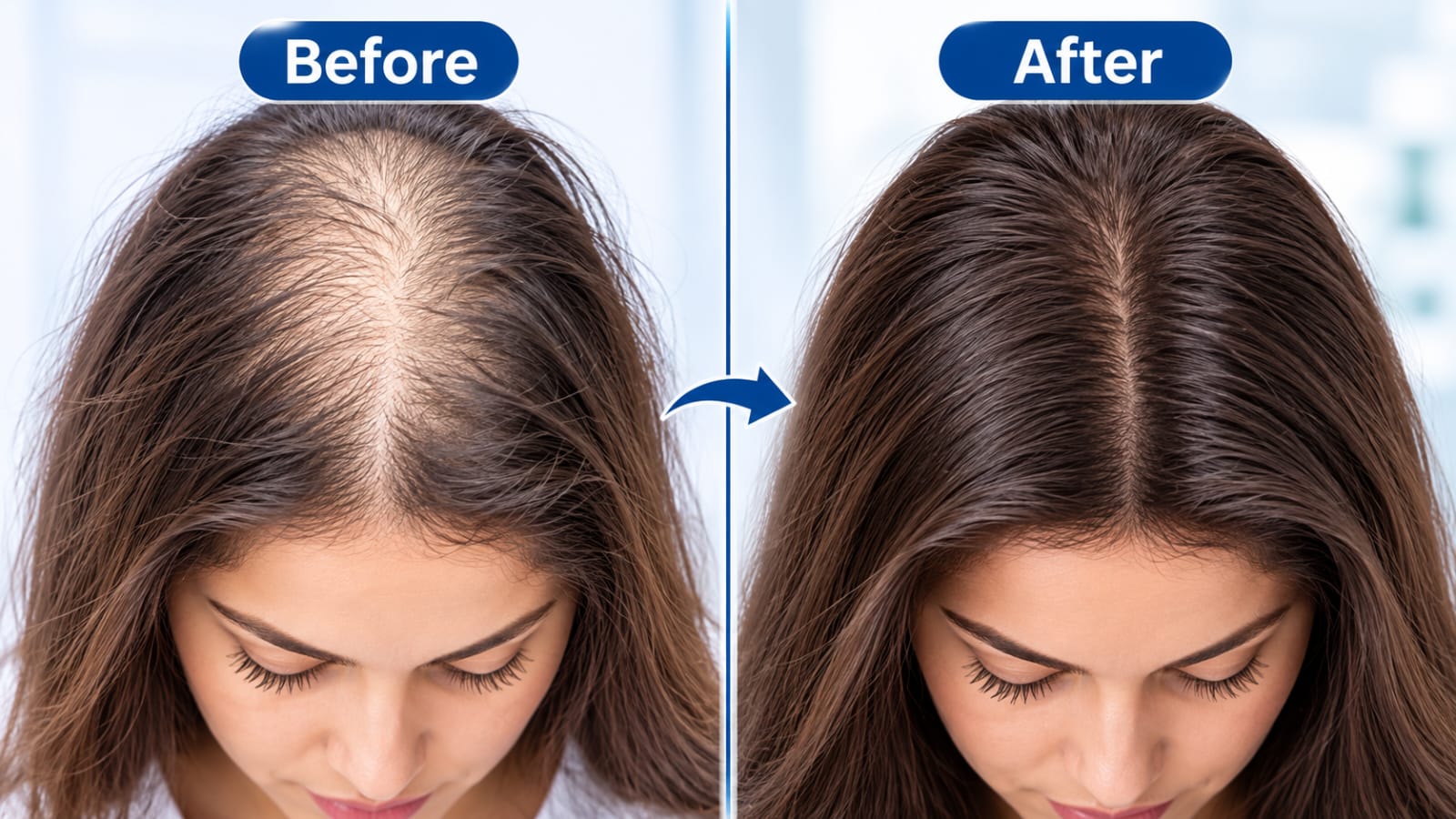
Alopecia Before and After
Minoxidil: What You Should Know
How effective is it? Minoxidil helps many people with pattern hair loss and can be a useful add-on in alopecia areata, but results vary and are not the same for everyone.
How long does it take? Expect at least a couple of months before you notice change, with a proper review at about 6 months. Some people notice more shedding in the first weeks, which is usually temporary.
What are the disadvantages?
- You need to keep using it. If you stop, the gains usually fade over the following months.
- Scalp irritation, dryness or itching can occur with the topical form.
- Unwanted facial or body hair growth can occur, mainly in women.
- Some people report headaches or dizziness.
- Oral minoxidil can affect blood pressure, heart rate and fluid balance, so it needs medical supervision.
How long can you safely use it? Many people use minoxidil for years under medical guidance. Your doctor should review your response and any side effects regularly.
Can Diet Help Alopecia Areata?
There is no proven diet that cures or prevents alopecia areata, and no strong evidence that cutting out specific foods will bring hair back. A balanced diet with enough protein, iron and vitamins supports healthy hair in general. Be cautious about strict elimination diets or expensive supplement packages promising a cure. If you suspect a deficiency, get tested.
Can Alopecia Areata Be Stopped From Spreading?
No one can guarantee this, because the condition is autoimmune and unpredictable. What you can do:
- See a dermatologist early rather than waiting
- Follow the treatment plan consistently
- Avoid harsh hair treatments and tight hairstyles on affected areas
- Look after sleep, stress and general health
- Ask about screening for linked conditions such as thyroid disease
The Emotional Side of Hair Loss
Hair loss is not only cosmetic. Research reviews show that alopecia can affect quality of life, mental health and even work confidence. If hair loss is making you anxious, withdrawn or low, say so during your consultation. Support, realistic expectations and options such as camouflage or scalp concealment solutions can make a real difference alongside medical treatment.
Is Alopecia Serious?
Alopecia areata and pattern hair loss are not life-threatening. But they can be distressing, they are often long-term, and scarring alopecia can cause permanent loss if untreated. Hair loss can also be a sign of an underlying medical issue, which is one more reason to get checked.
Alopecia Treatment at EDCC, Abu Dhabi
EDCC offers its care under the direction of Dr. Mouza Al Suwaidi, a Canadian Board-Certified Consultant Dermatologist. Your visit starts with a proper assessment so the treatment fits your type of hair loss, not a generic package.
What you can expect:
- A clear diagnosis and an explanation of what is causing your hair loss
- Honest expectations about what treatment can and cannot do
- A personalised plan, including timelines and follow-up
- A personalised quotation after your consultation
Areas of the skin that are affected by vitiligo or scars can also be concealed with medical camouflage at EDCC, a topical option that conceals colour differences without treating the underlying condition.
How to Judge Hair Treatment Results Realistically
Hair treatment is gradual, so before-and-after photos and online claims need to be read with care. Here is how to judge them honestly.
How to read before-and-after photos honestly:
- Check that the lighting, angle, hair length and parting are the same in both photos
- Look at the time between photos. Most hair treatments need 3 to 6 months or longer to show a clear change
- Remember that results vary from person to person, and photos you see online are not a promise of the same outcome
- Ask your doctor what a realistic result looks like for your type of hair loss before you start
Frequently Asked questions
FAQ
Options include JAK inhibitors such as baricitinib and ritlecitinib, and in some cases methotrexate or steroid-based treatments. The choice depends on your age, health and how long the condition has been present. Results vary and treatment is usually long-term.
It depends on the type. Pattern hair loss is managed with minoxidil, finasteride (men), oral minoxidil, laser therapy and PRP. Alopecia areata is managed with steroid injections, topical treatments and JAK inhibitors. Shedding from deficiency or stress is treated by correcting the cause.
Often yes, especially when treatment starts early and while follicles are still alive. Hair lost from scarring alopecia or long-standing advanced loss is much less likely to return.
In early stages, treatment can thicken miniaturised hairs and improve density. Once follicles have stopped producing hair for a long time, regrowth is limited.
It can help as an add-on to other treatments, particularly steroid-based ones, but it is not usually enough on its own for extensive alopecia areata.
Some people report headaches or dizziness, especially with oral minoxidil. Tell your doctor if this happens.
If it is working, you usually need to keep using it to maintain the results. Stopping often leads to gradual loss of the hair gained.
It needs long-term use, may cause irritation, shedding at the start, or unwanted hair growth, and oral forms need medical monitoring.
It is an autoimmune condition in which the immune system mistakenly attacks hair follicles. Genetics and other autoimmune or allergic conditions can play a role, and triggers vary between people.
Patchy beard hair loss is commonly alopecia areata affecting the beard, though fungal infection and other causes are possible. A dermatologist can tell them apart.
There is no guaranteed way. Early diagnosis, consistent treatment and avoiding scalp trauma give you the best chance of limiting progression.
It is not life-threatening, but it can affect emotional wellbeing and, in scarring types, cause permanent loss if untreated. See a dermatologist for diagnosis.
There is no proven food to avoid. Focus on a balanced diet, and get tested for deficiencies before taking supplements.