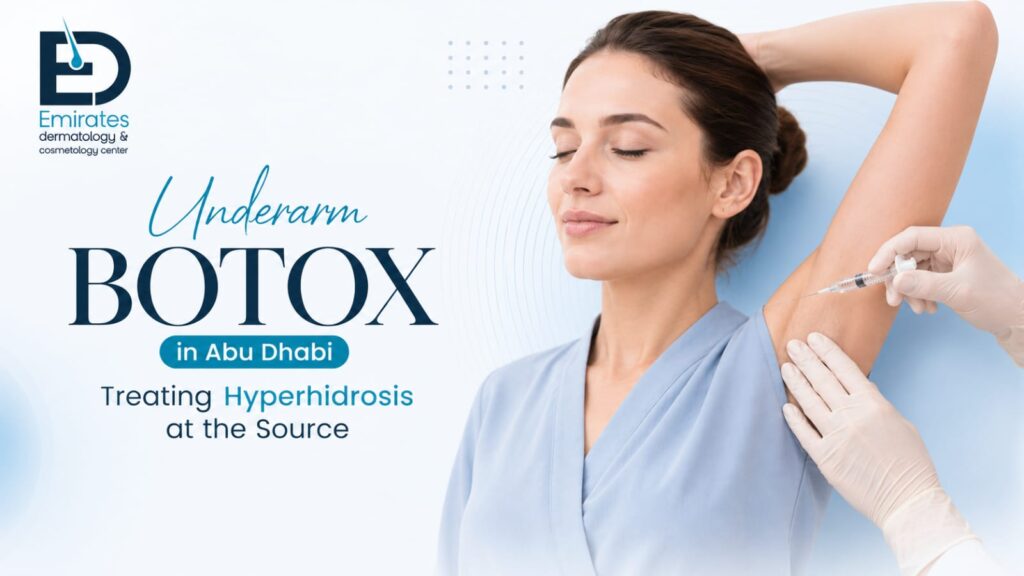
Excessive underarm sweating — medically known as axillary hyperhidrosis — isn’t just about warm weather or nerves. It’s caused by sweat glands that are wired to overreact, producing far more sweat than your body actually needs for temperature regulation. For many people in Abu Dhabi’s climate, this becomes a daily source of self-consciousness that antiperspirants alone don’t fully solve. Underarm Botox treats this directly, at the nerve level, rather than just masking the symptom.
At EDCC, hyperhidrosis treatment is medically reviewed and directed by Dr. Mouza Al Suwaidi, a Canadian Board-Certified Consultant Dermatologist — treated as a genuine medical concern, with a proper assessment before treatment, not a walk-in cosmetic add-on.
How Underarm Botox Actually Works
This is different from Botox for wrinkles, and worth understanding properly rather than taking on faith. Sweat glands are controlled by nerve fibers that release a chemical messenger called acetylcholine to trigger sweating — the same way nerves signal muscles to move. When botulinum toxin is injected into the skin over an overactive sweat gland area, it blocks that chemical signal at the nerve ending. The gland simply stops receiving the “sweat now” instruction. The rest of your body’s ability to regulate temperature through normal sweating elsewhere is unaffected.
Is It Actually a Medical Condition?
Yes — and this matters for how it’s assessed. Hyperhidrosis is typically diagnosed as primary (no underlying cause, often genetic, usually starting before age 25) or secondary (linked to a medical condition, medication, or another systemic cause). A proper consultation should rule out secondary causes before treatment begins — this isn’t a step to skip, since treating the wrong underlying cause with Botox alone wouldn’t solve the actual problem.
What to Expect: Step by Step
- Consultation & assessment — Dr. Mouza reviews your history to confirm this is primary focal hyperhidrosis, not a secondary condition needing separate treatment.
- Mapping (if needed) — a starch-iodine test can be used to precisely map the exact sweating pattern across the underarm, so injections cover the full affected area without treating skin that doesn’t need it.
- Numbing — topical anaesthetic cream is applied ahead of time, since the underarm has enough sensitivity that most patients prefer it.
- Injection — a fine needle delivers Botox across a grid pattern spanning the underarm area, with the exact unit count determined by the size of the affected area.
- Aftercare — avoid strenuous exercise and heat exposure for 24 hours; no other real downtime.
Results: What to Expect Honestly
Most patients notice a real reduction in sweating within 5 to 7 days, with full effect established by two weeks. For underarm (axillary) hyperhidrosis specifically, results typically last 6 to 9 months — not longer claims you may see elsewhere, which aren’t well supported. As sweat glands undergo repeated treatment cycles over time, some patients find the effect holds a little longer with each round.
Underarm Botox vs. Other Options
| Option | How it works | Downside |
|---|---|---|
| Prescription antiperspirants | Aluminium chloride blocks sweat ducts topically | Skin irritation is common; effectiveness fades over time |
| Oral medication (anticholinergics) | Reduces sweating body-wide | Systemic side effects — dry mouth, blurred vision, urinary retention |
| Iontophoresis | Mild electrical current disrupts sweat gland function | Needs frequent home sessions to maintain; less practical long-term |
| Underarm Botox | Blocks the nerve signal to overactive sweat glands directly | Requires repeat sessions every 6–9 months; no daily maintenance needed in between |
For moderate to severe underarm sweating that hasn’t responded well to antiperspirants, Botox generally offers the best combination of effectiveness and convenience — without the body-wide side effects of oral medication.
An Honest Look at Risks
Underarm Botox is well-established and generally very safe — but no injectable is entirely without effects, and claims otherwise aren’t accurate. The most common temporary effects are mild soreness or a small bruise at injection points, usually resolved within 2–3 days. Some patients notice temporary muscle weakness near the treated area, which resolves on its own. It’s important to understand this treatment reduces excessive sweating — it doesn’t eliminate normal sweating entirely, which is a healthy bodily function.
Cost of Underarm Botox in Abu Dhabi
The cost of treatment varies based on individual needs and the recommended treatment plan. Please contact EDCC to receive a personalised quotation after consultation.
Who’s a Good Candidate?
Likely a good fit if your sweating:
- Affects both underarms roughly equally
- Happens at least once a week regardless of temperature or activity
- Started before age 25, or runs in your family
- Disrupts daily life, clothing choices, or confidence
- Hasn’t responded adequately to prescription-strength antiperspirants
Best to postpone or avoid if you’re:
- Pregnant or breastfeeding
- Living with a neuromuscular condition such as Myasthenia Gravis
- Experiencing sweating that may have a secondary medical cause not yet investigated
Frequently Asked questions
FAQ
Typically 6 to 9 months for axillary hyperhidrosis specifically. Some patients find results last progressively longer with repeated treatment cycles.
Topical numbing cream is applied beforehand, which makes the injections considerably more comfortable — most patients describe a series of small pinches rather than significant pain.
No. The effect stays localized to the treated area — the toxin doesn’t enter the bloodstream at the doses used for hyperhidrosis, so your body’s overall ability to regulate temperature through sweating elsewhere is unaffected.
The cost of treatment varies based on individual needs and the recommended treatment plan. Please contact EDCC to receive a personalised quotation after consultation.
Ready to talk it through? Book a consultation with Dr. Mouza Al Suwaidi at EDCC — or explore related treatments: [Forehead Botox], [Frown Lines Botox], [Crow’s Feet Botox].